Getting Started with Redstone Episode 5 — Building Your First Automatic Farm with Observers and Pistons
This story was machine-translated from Korean.

Running around the water to harvest each sugar cane and pick up the dropped items gets boring fast. In this episode, we’ll let redstone handle that. The observer we learned about in Episode 4 will detect when the sugar cane grows, the piston from Episode 3 will harvest it, and the hopper will collect it into a chest. Everything we've learned so far will come together into one machine.
The goal of Episode 5 of "Getting Started with Redstone" is to create a farm that works just by following the layout of what goes where on each layer. So instead of a fancy design, I chose the simplest structure that clearly shows the principle. We’ll first build a fully automatic sugar cane farm, then use the same setup for bamboo, and finally create a semi-automatic farm for pumpkins and melons that can be harvested with the push of a button.
This is based on Java Edition. This design does not use the quasi-connectivity feature (from Episode 3) that is exclusive to Java. However, since the detection method and timing of observers differ in Bedrock Edition (as mentioned in Episode 4), I recommend testing it with a one-block setup first before expanding.
First, let's understand the properties of the crops.
| Crop | Planting location | Growing conditions | When pushed by a piston |
|---|---|---|---|
| Sugar Cane | Dirt, sand, clay, etc. | Water must be adjacent (not diagonal) to the planted block. Light is not needed. Up to 3 blocks high. | Breaks and drops items. |
| Bamboo | Dirt, sand, clay, etc. | No water needed. Must have a light level of 9 or higher at the top. Grows up to 12-16 blocks. | Breaks and drops items. |
| Pumpkins/Melons | Seeds must be planted on tilled soil. | Light level of 9 or higher at the stem. Fully grown stems will produce fruit in adjacent empty spaces (on dirt, clay, etc.). | Fruit breaks and drops items. |
The key is the last row. All three crops will drop items when pushed by a piston and break. Additionally, when the bottom block of sugar cane or bamboo is removed, the block above it will also break. So, if you push just the second block, the entire top will drop, leaving the bottom one to regrow. The reason for using clay will be explained in the item collection section.
Automatic Sugar Cane Farm — Starting with a One-Block Setup
First, create a one-block setup and confirm it works before expanding it sideways. There will be four rows from front to back: 'Water Row · Sugar Cane Row · Device Row · Back Row', and the height will include five layers, starting from below ground.
| Layer | Water Row | Sugar Cane Row | Device Row | Back Row |
|---|---|---|---|---|
| Layer 4 | Glass | Leave empty (this is where the third block will grow) | Observer — Face towards the sugar cane, red dot facing the back row. | Redstone Dust |
| Layer 3 | Glass | Leave empty (this is where the second block will grow) | Piston — Face towards the sugar cane. | Any block (for dust support) |
| Layer 2 | Glass | Planting sugar cane | Any block | — |
| 1st floor | Water | Mud | Any block | — |
| Under the ground | Any block (water support) | Hopper → Chest | — | — |
Building order
- Under the ground: Place a hopper below the sugar cane row, making sure the hopper's output faces the chest next to it. If you crouch and place the hopper while aiming at the chest, it will connect.
- 1st floor: Place mud on top of the hopper and pour one block of water in front of it. The mud and water must be adjacent.
- 2nd floor: Plant sugar cane on top of the mud. Place glass on top of the water, stacking it up to 4 blocks high to create a front wall. This wall prevents any fallen sugar cane from bouncing out into the water.
- 3rd floor piston: Place a piston on top of the device row's 2nd block. The piston faces the player, so if you place it while looking at the device row from the glass wall side, it will face the sugar cane.
- 4층 관측기: 피스톤 위에 관측기를 놓는다. 관측기는 빨간 점이 놓는 사람 쪽을 향하므로, 뒷줄 쪽에 서서 사탕수수 쪽을 바라보며 놓으면 얼굴이 사탕수수의 세 번째 칸 자리를 본다.
- Back row: Place a block on the 3rd floor right behind the piston, and put redstone dust on top of it (4th floor, right behind the observer's red dot).
How it works
When the sugar cane grows to the third block, the observer detects the change and sends a pulse to the redstone dust behind it. As learned in episode 1, the dust sends a signal to the block it’s on, which moves the connected piston. When the piston pushes the second block, it breaks, and the third block, which has lost its support, falls as well. This means you harvest 2 sugar canes at once.
The disappearance of the third block is also a change, so the observer sends another signal, but the piston only pushes the empty space once and stops. The observer only looks at the third block, so it doesn't react to the piston head's movement. This is why there’s no endless 'infinite operation' happening.
Expanding sideways
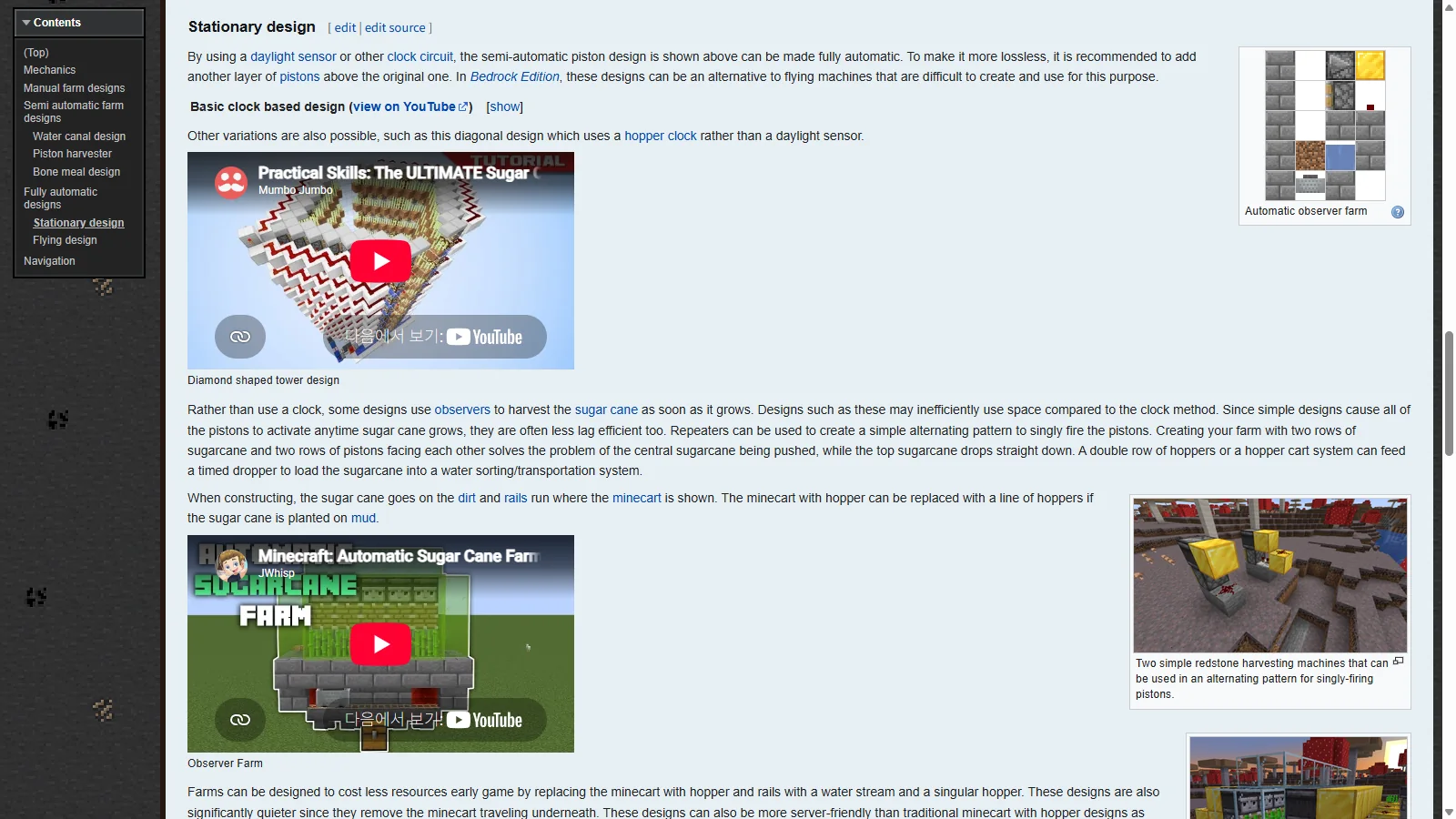
한 칸이 작동하면 같은 단면을 옆으로 이어 붙인다. 호퍼는 모두 한 방향으로 다음 호퍼를 향하게 이어 맨 끝 상자로 모은다. 줄 양 끝도 유리로 막는다. 이렇게 늘리면 뒷줄 가루가 하나로 이어져, 사탕수수 한 칸만 자라도 모든 피스톤이 함께 움직인다. 작동에는 문제가 없지만 피스톤 수만큼 계산이 늘어난다. Minecraft Wiki도 이런 단순 설계가 렉에 덜 효율적이라고 지적하며, 큰 농장에서는 리피터로 피스톤을 번갈아 움직이는 방법을 소개한다.
Bamboo farm using the same design
Minecraft The Wiki explains that bamboo breaks like sugar cane, so you can adapt the sugar cane farm design. Just plant bamboo instead of sugar cane in the above design. There are three differences.
- No water needed. You can remove the water from the water row. Just keep the glass front wall.
- Light is needed. The light level at the top must be 9 or higher for it to grow. If indoors, place torches.
- Grows faster. According to the Wiki, it grows about once every 204.8 seconds (around 3 and a half minutes) on average.
Bamboo can also be planted on mud, so you can use the same hopper collection structure.
Pumpkins and melons — harvest one row with a button
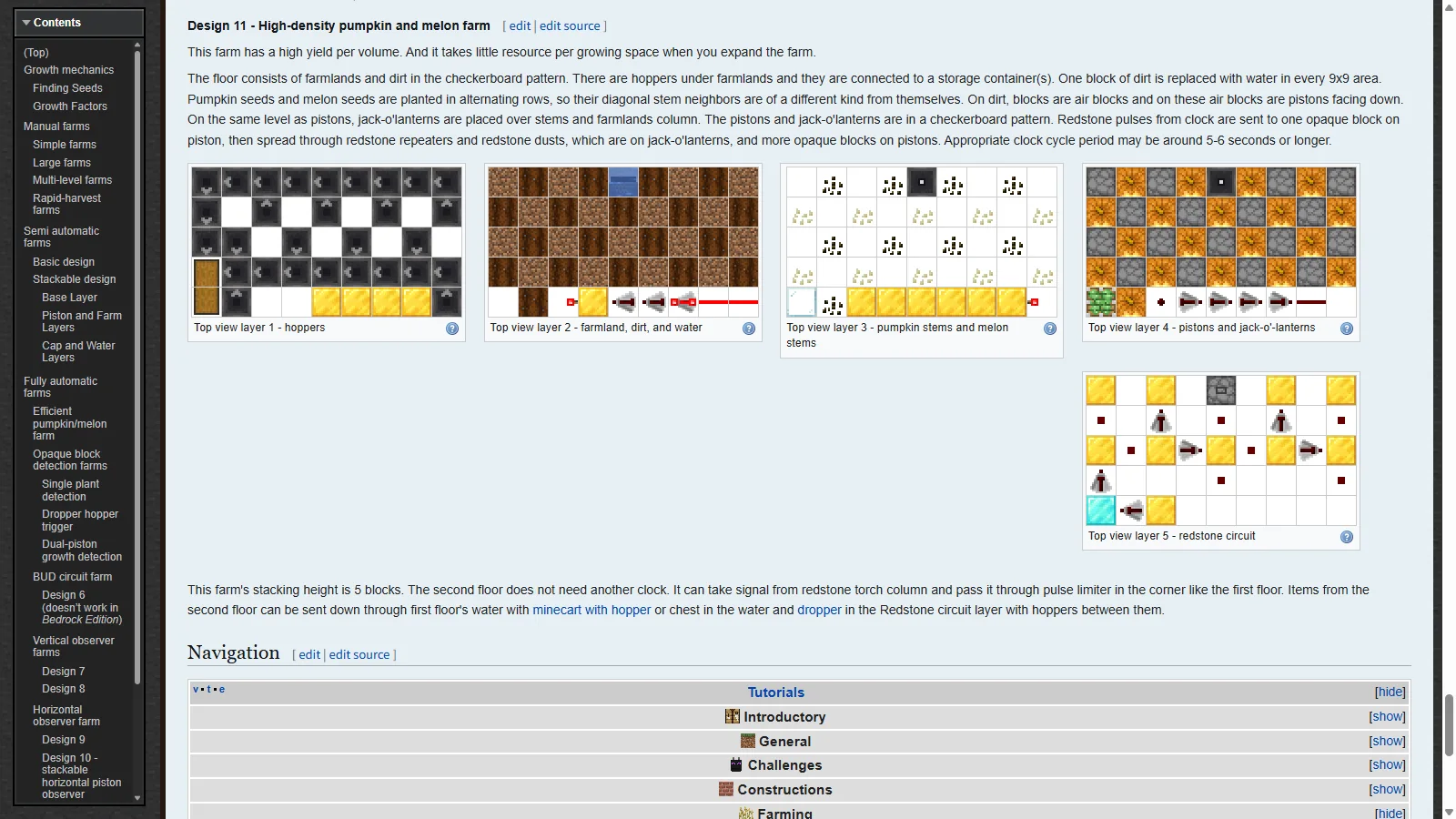
Pumpkins and melons work differently from sugar cane. If you watch the fruit spots with an observer, it detects the piston head moving in and out as a change, causing the piston to move endlessly (this is a warning from the Wiki). So, the first pumpkin and melon farm is built as a semi-automatic system that harvests one row at a time with a button. There are five rows: 'water row, stem row, fruit row, piston row, back row'.
| Layers | Water row | Stem row | Fruit row | Piston row | Back row |
|---|---|---|---|---|---|
| 3rd floor | — | — | — | — | Redstone dust (with a button at the end) |
| 2nd floor | Glass | Plant seeds | Leave empty (fruit spot) | Piston — the head faces the fruit spot | Any block |
| Layer 1 | Water | Farmland | Mud | Any block | Any block |
| Below ground | Any block | Hopper | Hopper | — | — |
- Below ground: Place two rows of hoppers under the stem row and fruit row, connecting them to a large chest at the end.
- Layer 1: Place dirt on top of the hoppers in the stem row and till it to create farmland. Put mud on top of the hoppers in the fruit row, and water in the water row. The water keeps the farmland moist.
- Layer 2: Plant pumpkin or watermelon seeds in the farmland and place glass on top of the water. Now, among the four blocks around the stem, only one spot is empty and has dirt below it, which is where the fruit will grow.
- Piston: Stand at the fruit spot and place the piston facing the fruit spot.
- Back row: Place a row of blocks behind the piston and lay powder on top. Add one more block at the end of the powder row and attach a button to the side.
When you press the button, the signal spreads from the block with the button to the blocks with powder, causing the pistons to extend all at once. The block with the fruit breaks, and the empty spot gets a false hit and returns. The piston head can push items toward the stem, so hoppers are placed below the stem row. The powder can reach up to 15 blocks, so make one row within 15 blocks. To allow growth at night, place torches near the stems.
완전 자동으로 가려면 두 가지 길이 있다. 하나는 버튼 자리에 4화의 클럭을 다는 것이다. 위키의 고밀도 설계는 주기를 5~6초 이상으로 권한다. 다른 하나는 자바 에디션에서 관측기가 열매 대신 줄기를 지켜보게 하는 것이다. 줄기는 열매를 맺으면 열매 쪽으로 휘고, 열매가 사라지면 곧게 돌아온다. 피스톤 머리를 보지 않으니 무한 작동이 없다. 배치가 한층 복잡해 이번 화에서는 원리만 소개한다.
Three methods for collecting harvests
| Method | Advantages | Disadvantages |
|---|---|---|
| Mud + Hopper row (this time) | Simple structure and almost no loss. Mud is lower than one block, so the hopper below collects the items above. | One hopper costs 5 iron ingots. It can get expensive with a long setup. |
| Hopper minecart + Rails | Lay rails under dirt or sand and run a hopper minecart to collect items above. Doesn't require mud and is common in wiki designs. | Noise from the minecart. Some servers restrict minecarts. |
| Waterway + One Hopper | Materials are cheap and quiet. Can be used on servers that prohibit minecarts. | Sometimes misses items that fall on sand. |
Tips to increase efficiency
- Must be nearby to grow. Crops only grow in loaded chunks. Build the farm close to your base.
- Sugar cane grows slowly. On Java, it takes about 18 minutes on average for one block (about 54 minutes on Bedrock) with a lot of variance. Increasing the number of blocks is the most reliable way to boost production. It doesn't need light, so it can be built underground.
- Bone meal cannot be used on sugar cane in Java. On Bedrock, it can grow up to three blocks at once.
- Waterlogged blocks count as water for sugar cane. You can use them to save space.
- Pumpkin and melon stems should be placed on mud or dirt, not farmland. If the fruit grows, it will turn the farmland below into dirt. Grass or leaf piles around the stem can also block fruit growth.
- One stem per fruit spot. Sharing a spot between two stems is a waste. A single stem won't grow new fruit while there's already one, so the theoretical maximum is one fruit per stem. The wiki suggests alternating pumpkin and melon rows.
- Lag management applies to farms too. Instead of connecting multiple farms where pistons move all at once, just build as many as you need.
Summary of Episode 5
- For sugar cane farms, signals flow in the order of observer (4 blocks) → powder → block → piston (3 blocks). The key is that the observer only watches the third block.
- For bamboo, you just need to replace water with light in the same structure.
- Pumpkin and melon will operate infinitely if you watch the fruit, so start with a button-operated semi-automatic setup.
- A hopper under mud is the simplest and least wasteful collection method.
In five episodes, we've gone from signal-based farms to fully automated ones. Show off your farms on the MINECAP building board, or if they're not working, post screenshots of each layer on the question board. If you can see what's in each layer, you'll quickly find the cause.
Reference materials
Want to talk about this story?
Share your take with other Minecraft players on MINECAP.